

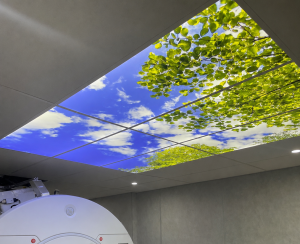
 The environment patients experience during treatment has a measurable impact on how they feel.
For more than 40 years, researchers have studied the relationship between healthcare design and patient wellbeing, finding that thoughtfully designed clinical environments can help reduce stress, improve comfort and contribute to a more positive healthcare experience. These findings have helped establish the field of evidence-based healthcare design, which continues to influence the design of modern hospitals worldwide.
One of the most influential studies was published in Science by Professor Roger Ulrich in 1984. The research found that patients recovering from surgery in rooms with views of nature experienced better outcomes than those whose windows overlooked a brick wall. Since then, hundreds of studies have explored how natural elements, including daylight, gardens, artwork and nature imagery, can positively influence patient experience.
 The Power of Positive Distraction
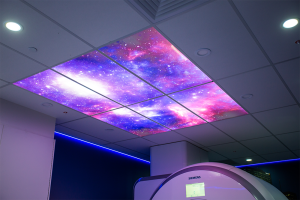
Healthcare environments can be intimidating. For patients undergoing MRI, CT or other imaging procedures, remaining still while looking at a blank ceiling can add to feelings of stress or anxiety.
Researchers describe natural scenery, artwork and other calming visual features as positive distractions, elements that gently draw attention away from stress while promoting a sense of calm. The concept has become one of the core principles of evidence-based healthcare design.
In 2004, The Center for Health Design published The Role of the Physical Environment in the Hospital of the 21st Century, bringing together decades of research into healthcare environments. The report concluded that design features such as access to nature, positive distraction and carefully planned patient environments can improve the overall patient experience while creating more welcoming healthcare facilities.
An updated review published in 2008 further reinforced these findings, highlighting the growing body of evidence supporting patient-centred healthcare design.

Bringing Nature Indoors
While not every imaging department or treatment room has access to natural daylight or garden views, technology now makes it possible to recreate many of these experiences indoors.
Virtual View® Skylights have been developed around these same evidence-based design principles.
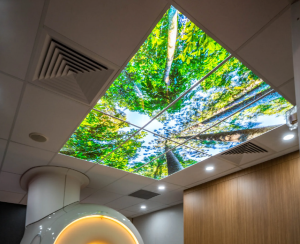
Using high-resolution illuminated imagery, Virtual View® creates the illusion of looking through a skylight into blue skies, forest canopies, tropical landscapes or peaceful night skies. Instead of staring at a blank ceiling, patients experience a calming visual focal point designed to soften the clinical feel of the room.
Importantly, Virtual View® does not claim to replace clinical care or directly improve medical outcomes. Rather, it supports the broader goal of creating healthcare environments that are warmer, more welcoming and centred around the patient.
 Designed for Modern Healthcare Facilities
Virtual View® systems are available in both standard modular configurations and fully customised designs, allowing them to integrate seamlessly into new hospital developments and existing healthcare facilities.
Whether installed in MRI suites, CT rooms, treatment areas or waiting spaces, each installation can be tailored to suit the architecture of the room. A comprehensive library of natural imagery, combined with custom artwork options, enables healthcare providers to create environments that reflect both their facility and the needs of their patients.
Healthcare Design Continues to Evolve
Today’s healthcare facilities are no longer designed solely around equipment and clinical workflows. Patient wellbeing has become an increasingly important consideration for architects, clinicians and healthcare providers alike.
Virtual View® Skylights embrace this philosophy by bringing biophilic design principles into spaces where traditional windows are simply not possible. By incorporating natural imagery and positive visual distraction, they help transform clinical environments into spaces that feel more comfortable, reassuring and human.
As the evidence supporting healing environments continues to grow, thoughtful design is becoming recognised as an important part of delivering exceptional patient care.
Author: Ben Hadfield
References
- Ulrich, R.S. (1984). View through a Window May Influence Recovery from Surgery. Science, 224(4647), 420–421.
- Ulrich, R.S., Quan, X., Zimring, C., Joseph, A., & Choudhary, R. (2004). The Role of the Physical Environment in the Hospital of the 21st Century. The Center for Health Design.
- Ulrich, R.S., et al. (2008). A Review of the Research Literature on Evidence-Based Healthcare Design. HERD: Health Environments Research & Design Journal.
- Malkin, J. (2003). The Business Case for Creating a Healing Environment. The Center for Health Design.