

The Philips Expression MR400 Patient Monitoring System is designed to support a broad range of physiological monitoring requirements within the MRI environment. While Non-Invasive Blood Pressure (NIBP) monitoring provides a convenient method of obtaining intermittent blood pressure measurements, some patient populations require continuous and highly accurate haemodynamic monitoring. For these situations, the MR400 incorporates Invasive Blood Pressure (IBP) monitoring capabilities.
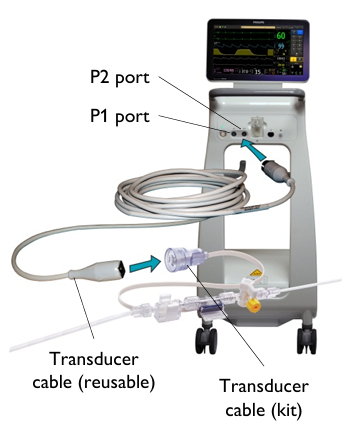
The MR400 can monitor up to two invasive blood pressure channels simultaneously, providing clinicians with continuous real-time pressure measurements from multiple sites if required. This capability is particularly valuable during complex procedures, critical care monitoring, and situations where precise blood pressure assessment is essential to patient management.
The two invasive pressure ports are located on the front of the MR400 and are labelled P1 and P2, allowing independent monitoring of two separate pressure sources at the same time.
What Is Invasive Blood Pressure Monitoring?
Before discussing the MR400 IBP functionality, it is important to understand how invasive pressure monitoring differs from conventional cuff-based blood pressure monitoring.
Unlike Non-Invasive Blood Pressure (NIBP) monitoring, which provides intermittent blood pressure measurements using an inflatable cuff, invasive monitoring measures pressure directly within the vascular system through a catheter and pressure transducer.
This direct measurement method allows clinicians to continuously assess haemodynamic status while also providing access to pressure waveforms and real-time physiological changes that may not be detected during intermittent cuff measurements.
Because the pressure is measured directly, IBP monitoring provides:
- Continuous real-time pressure measurements
- Greater accuracy than intermittent cuff measurements
- Immediate detection of haemodynamic changes
- Waveform analysis capabilities
- Improved monitoring of critically ill patients
This makes IBP monitoring particularly useful when rapid changes in patient condition are expected or when continuous blood pressure assessment is clinically required.
Common Clinical Applications
When equipped with the optional Invasive Blood Pressure (IBP) monitoring functionality, the MR400 supports a range of haemodynamic monitoring applications commonly encountered in critical care, anaesthesia, interventional procedures, and MRI environments.
Approved monitoring applications include:
- Direct arterial blood pressure (ABP) monitoring
- Central venous pressure (CVP) monitoring
- Pulmonary artery pressure (PAP) monitoring
- Left atrial pressure (LAP) monitoring when used with an air-eliminating filter
- Cardiac catheterisation procedure
The ability to continuously monitor these pressures provides clinicians with valuable real-time haemodynamic information and supports rapid identification of physiological changes that may require clinical intervention.
Dual-Channel Monitoring Capability
One of the key advantages of the MR400 IBP system is its ability to monitor two pressure channels simultaneously.
Using the P1 and P2 ports, clinicians can connect two independent transducers and monitor different anatomical locations at the same time.
For example, a clinician may wish to monitor:
- Arterial Blood Pressure and Central Venous Pressure simultaneously
- Pulmonary Artery Pressure and Arterial Pressure simultaneously
- Two separate invasive pressure measurements for research or specialist procedures
This dual-channel capability provides greater monitoring flexibility while reducing the need for additional equipment in the MRI environment.
When two invasive pressure channels are connected, the MR400 displays each channel independently, allowing clinicians to view separate waveforms and numerical values simultaneously.
The ability to display multiple pressure measurements side-by-side provides valuable clinical insight and allows for comparison between different haemodynamic parameters in real time.
Connecting an IBP Transducer
The MR400 is compatible with standard invasive pressure transducers featuring a sensitivity of 5 μV/V/mmHg and supports monitoring through two dedicated invasive pressure channels, P1 and P2.
Connection is achieved using an MR400-compatible invasive pressure transducer interface cable connected to either the P1 or P2 port on the front of the monitor. The opposite end of the cable interfaces with the transducer assembly used to obtain the physiological measurement.
While the original Philips reusable transducer interface cable is no longer available, compatible replacement interface cables are available to support ongoing operation of the MR400 invasive pressure monitoring system.
Depending on clinical requirements, users may connect:
- A single transducer to either P1 or P2
- Two independent transducers simultaneously using both channels
The MR400 invasive pressure monitoring system supports reusable interface cables and disposable transducer kits, allowing facilities to utilise their preferred workflow and infection-control practices.
Prior to patient connection, all fluid pathways should be properly primed and confirmed to be free of air bubbles. Air within the pressure monitoring system can introduce measurement errors, affect waveform quality, and result in inaccurate pressure readings. For this reason, all tubing, stopcocks, and transducer assemblies should be flushed and inspected carefully before monitoring begins.
As with all patient-contact accessories, disposable components should be used in accordance with hospital infection-control policies and manufacturer recommendations.
MRI Environment Considerations
As with all physiological monitoring equipment used within the MRI environment, careful setup of the invasive pressure monitoring system is essential for both patient safety and measurement accuracy.
Before commencing monitoring, users should ensure that:
- The transducer is levelled appropriately relative to the patient’s heart
- All tubing and cable connections are secure
- Air has been completely removed from the fluid pathway
- Transducer interface cables are not looped
- Cables do not rest on or contact the patient unnecessarily
- The transducer is positioned away from sources of vibration where practical
Attention should be paid to cable routing. Any transducer or interface cable that becomes looped during an MRI examination may act as a conductive pathway for RF-induced currents, potentially resulting in excessive heating and patient injury.
In addition, the invasive pressure transducer itself should never be attached directly to the patient and should remain outside the 5,000-gauss line specified by Philips.
Correct setup and positioning help ensure reliable pressure measurements while minimising risks associated with MRI procedures.
The Importance of Zeroing the Transducer
Accurate invasive pressure monitoring depends upon establishing a valid atmospheric pressure reference point. This process, known as zeroing, allows the MR400 to accurately calculate patient pressure measurements.
The transducer should be zeroed:
- During initial setup
- When a new transducer or tubing set is connected
- Daily as part of routine setup
- When the transducer is placed in its final monitoring position
- Whenever the transducer cable is reconnected to the MR400
- After moving or repositioning the patient
- After repositioning the transducer
- Whenever pressure measurements appear inaccurate
- In accordance with local facility policies
Particular attention should be paid to transducer positioning within the MRI suite. Because movement within the magnetic field can introduce measurement offsets, Philips recommends performing the final zeroing procedure only after the transducer has been placed in its intended monitoring position.
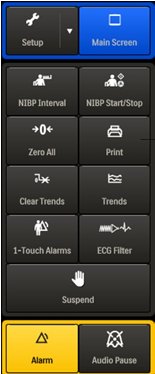
Once the transducer system has been connected and prepared, users can select the Zero All button available from the MR400 quick-access menu. The monitor will then perform the zeroing procedure for all connected invasive pressure channels simultaneously.
Proper levelling and zeroing remain among the most important steps in obtaining accurate invasive blood pressure measurements.
Understanding Pressure Channel Labels
By default, the MR400 identifies invasive pressure channels simply as P1 and P2. While functional, these default labels provide little indication of the physiological parameter being monitored.
To improve clarity, users can assign predefined clinical labels to each pressure channel using the Set Label function within the IBP parameter menu.
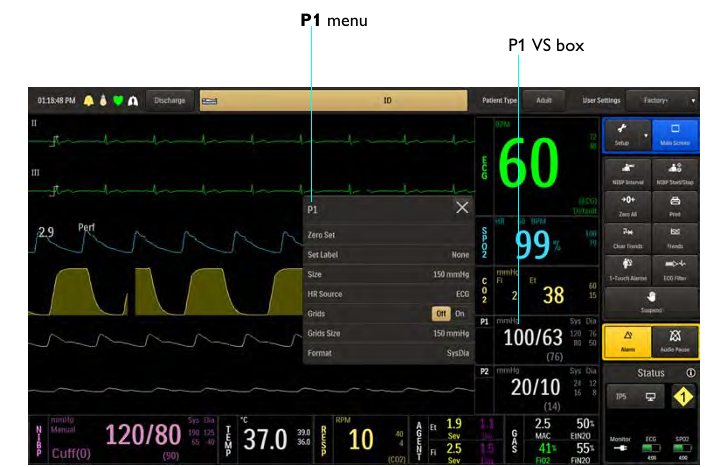
Available labels include:
- ABP (Arterial Blood Pressure)
- PAP (Pulmonary Artery Pressure)
- CVP (Central Venous Pressure)
- LAP (Left Atrial Pressure)
- ICP (Intracranial Pressure)
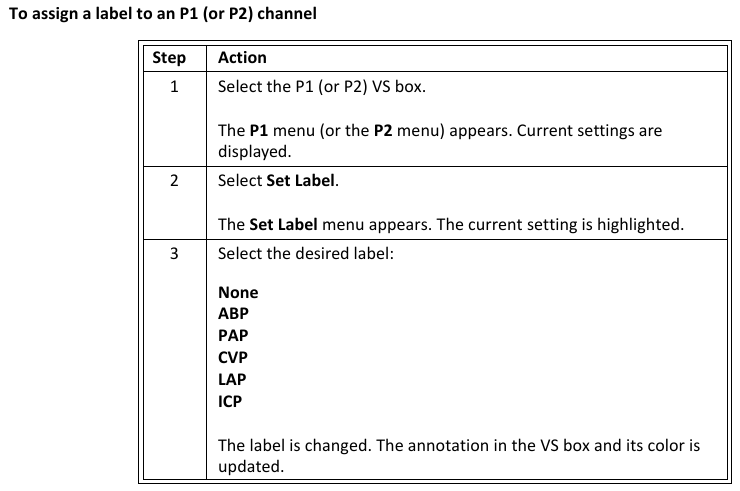
Each label is displayed using a dedicated colour on the MR400 interface, allowing clinicians to quickly differentiate between monitored pressure sources when multiple channels are displayed simultaneously:
- ABP displayed in pink
- PAP displayed in yellow
- CVP displayed in blue
- LAP displayed in purple
- ICP displayed in light blue
Applying descriptive labels improves user awareness, reduces the risk of confusion, and enhances workflow efficiency during patient monitoring.
This feature becomes particularly valuable when two invasive pressure channels are in use concurrently, ensuring that operators can immediately distinguish between monitored pressure sources.
Monitoring During the MRI Examination
Once invasive pressure monitoring has been established, clinicians should continue to observe both the patient and the displayed pressure waveforms throughout the examination.
Particular attention should be paid to:
- Waveform quality
- System alarms
- Pressure trends
- Transducer positioning
- Patient safety
As with other MRI-compatible monitoring accessories, users should periodically confirm that excessive heating is not occurring and that all cables remain correctly positioned throughout the procedure.
If the patient or pressure monitoring equipment is repositioned during the examination, the transducer system should be reassessed and re-zeroed if required to maintain measurement accuracy.
Conclusion
The Philips MR400 Invasive Blood Pressure monitoring system significantly expands the haemodynamic monitoring capabilities of the MR400 platform, providing clinicians with continuous, real-time pressure measurements throughout MRI examinations and other specialised monitoring applications.
With support for dual-channel monitoring, compatibility with reusable and disposable transducer systems, dedicated MRI-compatible interface cabling, flexible pressure labelling, and simplified transducer zeroing procedures, the MR400 provides a robust solution for invasive pressure monitoring within the MRI environment.
Whether monitoring arterial blood pressure, central venous pressure, pulmonary artery pressure, or other invasive pressure parameters, the system delivers valuable haemodynamic information that can assist clinicians in identifying physiological changes rapidly and accurately.
Understanding proper setup procedures, transducer positioning requirements, pressure channel configuration, and the importance of levelling and zeroing allows users to maximise measurement accuracy while maintaining patient safety throughout the monitoring process.
Philips MR400 Invasive Blood Pressure Monitoring FAQs
1. What is Invasive Blood Pressure (IBP) monitoring?
Invasive Blood Pressure (IBP) monitoring measures blood pressure directly within the vascular system using a catheter and pressure transducer. Unlike Non-Invasive Blood Pressure (NIBP) monitoring, which provides intermittent cuff-based measurements, IBP monitoring delivers continuous real-time pressure readings, allowing clinicians to detect haemodynamic changes immediately and assess pressure waveforms throughout a procedure.
2. Can invasive pressure monitoring still be used if the original Philips transducer cable is no longer available?
Yes. Although the original Philips reusable invasive pressure transducer interface cable has been discontinued, compatible replacement interface cables remain available. These cables allow healthcare facilities to continue using the MR400 Invasive Blood Pressure monitoring functionality with compatible transducer systems.
When replacing an interface cable, it is important to ensure that the cable is designed specifically for use with the MR400 and the selected invasive pressure transducer system to maintain monitoring accuracy and patient safety.
3. What types of invasive pressures can be monitored with the MR400?
The MR400 supports a range of invasive pressure monitoring applications commonly used in critical care, anaesthesia, and procedural environments. Supported pressure labels include ABP (Arterial Blood Pressure), PAP (Pulmonary Artery Pressure), CVP (Central Venous Pressure), LAP (Left Atrial Pressure), and ICP (Intracranial Pressure).
The system can monitor up to two invasive pressure channels simultaneously through its dedicated P1 and P2 inputs, enabling clinicians to assess multiple haemodynamic parameters in real time.
4. Why is zeroing the pressure transducer important?
Zeroing establishes the atmospheric pressure reference point required for accurate invasive pressure measurements. The transducer should be zeroed during initial setup, after repositioning the transducer, following disconnection and reconnection of the system, or whenever measurement accuracy is in question.
The MR400 simplifies this process through the convenient Zero All function, which can zero all connected pressure channels simultaneously.
5. How do pressure channel labels improve patient monitoring?
By default, invasive pressure channels are identified as P1 and P2. However, the MR400 allows users to assign descriptive labels such as ABP, CVP, PAP, LAP, or ICP through the IBP parameter menu.
Applying appropriate labels makes it easier to identify monitored pressure sources, reduces the risk of confusion when multiple channels are in use, and improves overall workflow efficiency during patient monitoring.