
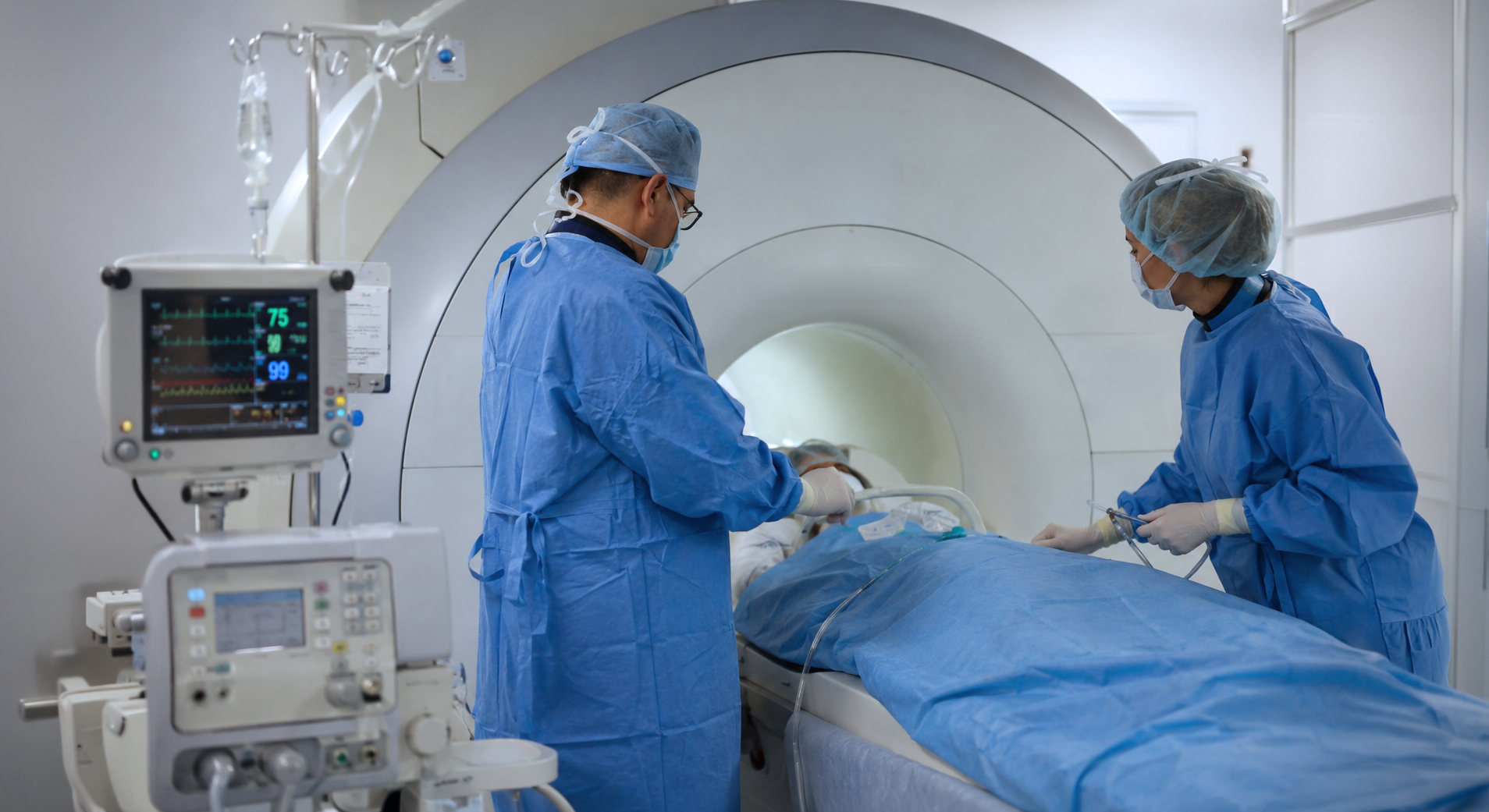
MRI is often thought of as a place to see. With the right interventional devices, it can also become a place to act.
In an MRI-guided procedure, image quality is only part of the equation. The path from scan to target also depends on an interventional device designed for the MR environment—one that gives the clinician practical control over access, positioning and penetration depth.
That is the thinking behind ITP’s KIM interventional cannulas. Rather than being limited to one anatomy or one application, the range has been developed for a broad selection of MRI-guided minimally invasive diagnostic and therapeutic procedures. Where tissue acquisition is required, ITP’s complementary BIM biopsy needles provide a dedicated sampling option.
Why MRI guidance changes the procedural view
MRI offers strong soft-tissue contrast without the use of ionising radiation. For procedures involving deep, small or complex anatomical targets, that ability to visualise soft tissue can provide clinicians with a valuable procedural view.
However, imaging capability alone is not enough. The needle or cannula must also be suitable for the MR environment and designed to support the planned access route.
The ITP KIM cannulas were developed specifically for MRI-guided minimally invasive therapy and diagnostics. Their design focuses on firm guidance, low penetration force and controlled positioning, helping connect the planned trajectory on the image with physical access to the target.
Far more than a prostate-biopsy product
Prostate biopsy may be one of the first procedures people associate with MRI-compatible needles, but it is far from the whole story.
The KIM interventional cannula range is intended for applications including:
- Spinal pain therapy, including periradicular therapy and facet joint infiltration
- Lumbar and thoracic sympathicolysis
- Diagnostic fine-needle aspiration biopsy
- Direct MRI arthrography
- Microtherapy
- Injection and introducer-needle procedures
This breadth is important for hospitals and imaging centres considering how MRI could support a wider interventional service. Instead of approaching the cannula as a single-procedure consumable, departments can consider it as a configurable access option across several clinical workflows.
Small design details that support procedural control
During an image-guided intervention, seemingly small design elements can play an important role in how a device is prepared, positioned and advanced.
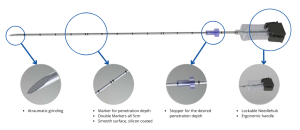
The KIM cannulas include a movable stopper that allows the planned penetration depth to be preset. The needles are marked at 10 mm intervals, with increased markings every 50 mm, supporting visual depth reference during preparation and use.
Other design features include a smooth coated surface, an ergonomic handle and a lockable needle hub. Selected versions incorporate a locking cap designed to prevent unwanted movement of the stylet. Standard-tip and trocar-tip configurations are available for different access requirements.
A range designed around the procedure
MRI-guided procedures do not all involve the same target depth, access route or device diameter. A short needle suitable for one intervention may be inappropriate for another.
Across the KIM range, available configurations extend from 30 mm to 200 mm in length and from 25G to 13G in diameter, depending on the selected standard or guiding-cannula configuration. This allows clinical teams to select the device around the intended procedure rather than trying to adapt one needle geometry to every application.
The cannulas are single-use and are supplied sterilised and individually packaged.
When access needs to become tissue acquisition
Where the objective is to obtain a tissue sample, ITP’s BIM ultralight semiautomatic biopsy needles complement the KIM range.
BIM biopsy needles are available in 14G, 16G and 18G diameters and in lengths of 100 mm, 150 mm and 200 mm. Depending on the configuration, biopsy lengths of 10 mm or 20 mm are available. The product range also identifies corresponding KIM guiding needles for each BIM biopsy-needle configuration.
This creates a broader story than prostate biopsy alone: an MRI-compatible product family that can support both access and sampling across different minimally invasive diagnostic workflows.
The small device between the image and the procedure
Hospitals already depend on MRI to provide detailed diagnostic information. The next question for departments developing MRI-guided procedures is whether their interventional toolkit is ready to work within that environment.
The needle may be one of the smallest components in the procedure, but it is also the point at which the image becomes an intervention.
Explore the ITP MRI-compatible interventional cannula range and speak with us about the available configurations.