

Bringing Bedside-Quality Monitoring into the MRI Suite
Patient monitoring inside the MRI environment has always presented unique challenges. Clinicians need access to accurate, reliable patient data while working within one of the most demanding environments in healthcare. The ability to maintain visibility of a patient’s condition throughout an MRI examination is not simply about technology. It is about supporting clinical confidence, patient safety, and better outcomes when they matter most.
The Philips Expression MR400 MR Patient Monitor was designed to bridge the gap between traditional MRI monitoring and bedside patient monitoring. As Philips’ most advanced MR monitoring system, the MR400 brings bedside-quality monitoring capabilities into the MRI suite, helping clinicians make informed decisions without compromising workflow or patient care. At Imaging Solutions, we are proud to partner with Philips to provide and support the distribution of the MR400 across Oceania, helping healthcare providers access the latest innovations in MRI patient monitoring.
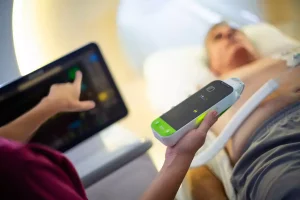
Continuity of Care Throughout the MRI Journey
The MR400 combines the familiarity of a bedside monitor with technology specifically engineered for the MRI environment. Whether supporting intra-operative MRI procedures, complex cardiac examinations, or functional MRI studies, the system provides clinicians with the information they need to monitor patients confidently throughout their scan.
By delivering continuity of monitoring across different care environments, the MR400 helps healthcare teams maintain a consistent standard of care from the bedside to the MRI suite and back again.

Designed for the Demands of MRI
Designed with both clinicians and patients in mind, the Expression MR400 delivers the confidence and functionality expected from a modern bedside monitoring solution while meeting the unique demands of MRI.
Its 15-inch widescreen LED display and intuitive touchscreen interface provide clear visibility of patient vital signs in a format that is immediately familiar to healthcare staff. With compatibility up to 5,000 Gauss, support for both 1.5T and 3.0T MRI systems, and operation at 7.2 µT B1 rms and 4 W/kg SAR, the MR400 offers the flexibility required for a wide range of clinical applications.

Comprehensive Patient Monitoring Capabilities
Beyond MRI compatibility, the MR400 provides comprehensive patient monitoring through Wireless ECG, Wireless SpO₂, NIBP, IBP, CO₂, Temperature, and Anaesthetic Agent monitoring.
This breadth of monitoring allows clinicians to maintain visibility of critical patient information throughout the MRI procedure, supporting informed decision-making and enhanced patient care.
Advanced Monitoring Intelligence and Safety Features
One of the standout features of the MR400 is its advanced monitoring intelligence. Technologies such as Wireless ECG 3.0 have been specifically developed to address the challenges associated with ECG monitoring in MRI environments.
Combined with bedside-level SINC (SpO₂, IBP, NIBP, CO₂) parameters, multi-priority alarm management, and dedicated alerts for conditions such as apnea, extreme bradycardia, and extreme tachycardia, the system helps clinicians identify and respond to changes in patient condition quickly and effectively.
Additional features including Gauss Detection, MAC value monitoring, and advanced alarm flags further enhance patient safety by providing early warning indicators and supporting proactive clinical intervention. Together, these capabilities represent a significant step forward in MRI patient monitoring, bringing clinicians closer to the ideal of delivering consistent, bedside-quality care regardless of where the patient is within the hospital.
Supporting Healthcare Providers Across Oceania
At Imaging Solutions, we understand that investing in MRI monitoring technology is about more than specifications. It is about equipping healthcare professionals with the tools they need to deliver safe, efficient, and patient-focused care.
Through our partnership with Philips, we are committed to helping healthcare providers across Australia and Oceania implement advanced MRI monitoring solutions such as the Expression MR400, supported by local expertise, service, and ongoing technical support.
As MRI procedures continue to evolve and patient acuity increases, solutions like the MR400 are helping redefine what is possible within the MRI suite, delivering greater confidence for clinicians and a safer experience for patients alike.
MR400 frequently asked questions
How long do the batteries last?
With new, fully charged batteries, Philips specifies a minimum of six hours for the MR400 monitor, depending on the enabled parameters and settings. The wireless ECG and SpO₂ module batteries provide approximately eight hours. Actual runtime varies with battery condition and use, so check the displayed battery status before each procedure.
How often do we need to change the water traps?
Inspect the water trap after each patient and replace it when full. Replacement depends on fluid accumulation, rather than a fixed number of days. Do not empty, clean or reuse a filled trap. Follow the instructions supplied with your monitor and consumables.
How often should the sample lines be changed?
Sample lines, cannulas and airway adapters are single-use accessories: use new accessories for each patient and discard them after use. Replace the sample line during monitoring if secretions appear.
Which MR400 configuration should I choose for my application?
Start with the parameters your clinical team needs. All configurations listed on our product page include ECG, SpO₂, non-invasive blood pressure and end-tidal CO₂. The differences are invasive blood pressure, temperature, and anaesthetic agent monitoring.
As a practical guide, consider L1 when the core parameters meet your requirements, C2 when invasive pressure is also required, or C3 when temperature is needed. For procedures requiring anaesthetic agent monitoring, select C4–C7 according to the additional parameters required. C7 provides the complete parameter set shown in the table.
The final choice should reflect your patient population, procedure mix, and clinical protocols. Contact Imaging Solutions to discuss the configuration and accessories for your application. View MR400 configurations
What systems does the MR400 integrate with?
The MR400 connects with the Philips MR Patient Care Portal 5000 for remote monitoring and hospital information system connectivity. With the appropriate setup, it supports integration with Philips IntelliVue Information Center iX (PIC iX) for central monitoring, as well as electronic medical record workflows.
The Portal 5000 is required for the remote connectivity described by Philips. Compatibility with your hospital’s systems, software versions, and interfaces should be confirmed during planning. Philips MR monitoring connectivity