

Picture a staff member helping in an unfamiliar procedure room. They know which consumable they need. Finding it is another matter.
One drawer opens, then another. Eventually, a colleague points them in the right direction.
It is a small moment, but a useful starting point for thinking about storage. How easily could someone use your supply cart without asking where things belong?
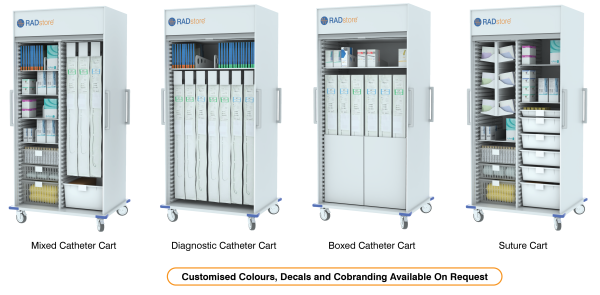
For RADstore Supply Carts, that question brings one feature into focus: the ability to configure the space inside.
What a search for supplies can reveal
A quality improvement project at the Royal United Hospital in Bath examined how long junior doctors took to collect equipment for venepuncture and cannulation on unfamiliar wards.
In the initial comparison, the medical admissions unit, which grouped the equipment on a single trolley, recorded a mean collection time of 21 seconds. The mean across the other wards was 103 seconds. The team subsequently introduced a standard trolley layout using inventories and labelled drawer inlays. Read the published report.
This was a single-hospital project involving a particular set of tasks, rather than a test of RADstore. Its relevance is the question it raises: how much of the effort involved in collecting supplies comes from figuring out where they are?
A place for everything starts with the layout
RADstore Supply Carts are compatible with the FlexCell modular storage system. That compatibility provides a starting point for configuring storage around a department’s supplies and working practices. Explore RADstore Supply Carts.
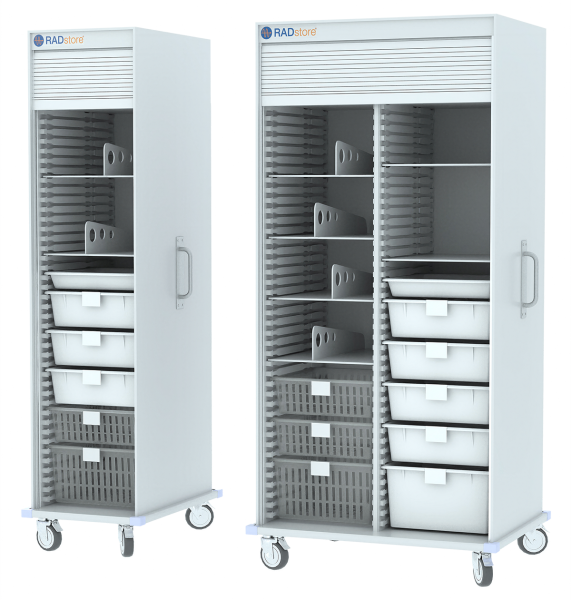
The FlexCell system includes trays, baskets, shelves and dividers that allow interiors to be arranged and reconfigured as requirements change. Adjustable dividers help organise different types and sizes of supplies within the available space.
The practical opportunity is to give each item an agreed location. A compartment can separate similar-looking packs. A clearly labelled space can show where an item belongs even when it has run out.
Consider starting with one frequently used tray. Ask the people who use and replenish it to agree on its contents and arrangement. Then invite a colleague less familiar with that room to locate several items. Their hesitation may reveal something the regular team no longer notices.
Make restocking part of the design
A useful layout also needs to make sense to the person replenishing it.
An empty compartment is only informative if someone knows what should be there. Pairing defined storage spaces with clear item descriptions and agreed stock quantities can make the intended arrangement easier to maintain.
There is a relevant example in the NHS’s Well Organised Unit guide. An endoscopy team tackled overflowing cupboards, over-ordering and outdated stock by reorganising storage, labelling cupboards and maintaining regular audits. Staff responsible for ordering could then see more clearly what needed replacing.
Keep the layout familiar as needs change
Departments change their consumables, packaging and procedures. A layout that worked well at installation may eventually need adjusting.
RADstore’s FlexCell compatibility makes that adaptability relevant beyond the initial purchase. The opportunity is to revise the interior when requirements change, then establish and communicate the updated layout.
For carts serving similar tasks, consider consistent locations for common items. Where requirements differ, give those differences clear labels. Involve the people using the carts across different shifts, as well as those responsible for restocking them.
A useful place to begin is one cart, one tray and one recurring search. Agree on a layout, try it during everyday work and review whether supplies are easier to find and replenish.
The next time someone asks, “Where are the supplies?”, their answer could help shape a better storage system.
Explore RADstore Supply Carts and discuss a configuration for your department with Imaging Solutions.